
Wednesday, 4 March 2015


Gmail, Yahoo, Live is Banned by Govt for Official Work
GMail Login: With increase in the cyber snooping on the Governments around the world, The Government of India had banned usage of GMail for Official work by the Govt. Staff to protect the users ( Govt. Staff) and Govt Data.
The email policy which is drafted by The Department of Electronics and Information Technology (DEITY) in October 2013 is implemented by the Government after taking the views from all the ministries.This policy is aimed to protect the sensitive data of Government.
NOW GMAIL LOGIN IS NOT POSSIBLE IN GOVT. OFFICES

GMail Banned in Govt Offices
The Government said in the notification that “The e-mail services provided by other service providers shall not be used for any official communication,” .This decision is took by Central Government and will be followed by both government employees of both central government and state government including the UT also.
This policy strictly says that no Government employee should use the Gmail login or any other foreign E-Mail accounts like Yahoo mail, HotMail for the official work by the staff, And the staff should use the E-Mail services provided by only NIC.
Due to this policy all the government data shall be passing from the Government Servers covering nearly 5-6 lakh Central and State government employees.
And the notification also says that NIC will be Monitoring the activities of the staff and have the power to access the access, review, copy or delete any files on the server of any users (Govt. Staff) for security reasons.

‘Go India’ Smart Card for Train Tickets
‘Go-India’ smart card scheme has been launched on pilot basis on two sectors i.e. New Delhi-Mumbai and New Delhi-Howrah. At present, the Go-India smart card enables passengers to pay for reserved and unreserved tickets. The smart card can be used at nominated Unreserved Ticketing System (UTS)/Passenger Reservation System (PRS) counters and at Automatic Ticket Vending Machines (ATVMs) on these two sectors for issuing tickets. The salient features of the Go-India smart card are as under:
Initially, the card can be get issued by paying minimum Rs.70/- where passenger will get Rs.20/- balance.After that, card can be recharged for Rs.20/- or in multiple of Rs.50/- upto Rs. 5000/-.
Maximum limit on Go-India smart card is Rs.10,000/-.
Go-India smart card has life time validity. In case of no usage in six months from the date of last transaction, smart card will be temporarily deactivated which can be activated again by paying Rs.50/- as activation fee.
The scheme is intended to reduce the transaction time at the booking counters for the convenience of passengers as it facilitates cashless transaction.
This information was given by the Minister of State for Railways Shri Manoj Sinha in written reply to a question in Lok Sabha today.
Seventh Pay Commission likely to submit report in October 2015
After 14th Finance Commission, 7th pay panel’s report looms : LiveMint
Read at: http://www.livemint.com
Finance ministry fears that its revenue will be affected in 2016-17 as it has to absorb new pay panel recommendations
New Delhi: After the recommendations of the Fourteenth Finance Commission (FFC) forced the government to reduce its plan expenditure in the 2015-16 budget, the Union finance ministry fears its revenues will remain constrained in 2016-17 as well since it has to absorb the recommendations of the Seventh Pay Commission (SPC) in that year.
The Seventh Pay Commission will submit its report by October 2015.
Click here for details of provision for 7th CPC in union Budget -2015-16
“The 7th Pay Commission impact may have to be absorbed in 2016-17. The phase of consolidation, extended by one year, will also be spanning out in this period. Thus, in the medium-term framework, the fiscal position will continue to be stressed,” the finance ministry said in the macroeconomic framework statement laid before Parliament along with the budget on Saturday.
The government appointed the Seventh Pay Commission on 28 February 2014 under chairman justice Ashok Kumar Mathur with a timeline of 18 months to make its recommendations. Though the deadline for submitting the report ends in August this year, the Seventh Pay Commission is likely to seek extension till October.
The Sixth Pay Commission which was constituted in October 2006 had submitted its report in March 2008.
As a result of the recommendations of the Sixth Pay Commission, pay and allowances of the Union government employees more than doubled between 2007-08 and 2011-12—from Rs.74,647 crore to Rs.166,792 crore, according to the Fourteenth Finance Commission estimates.
“As a ratio of GDP, it jumped from a little over 0.9% in 2007-08 to 1.2% in 2008-09 and about 1.4% in 2009-10 on account of both pay revision and payment of arrears. However, it moderated to little over 1% in 2012-13,” the Finance Commission said.
The recommendations of the Sixth Pay Commission were implemented by states with a delay mainly between 2009-10 and 2011-12, with “significant expenditure outgo” in arrears on both pay and pension counts, the FFC said.
The FFC said that while the finance ministry projects an increase in pension payments by 8.7% in 2015-16, a 30% increase is expected in 2016-17 on account of the impact of the Seventh Pay Commission, followed by an annual growth rate of 8% in subsequent years.
However, it maintained that given the variations across states and the lack of knowledge about the probable design and quantum of award of the Seventh Pay Commission, it is neither feasible, nor practicable, to arrive at any reasonable forecast of the impact of the pay revision on the Union government or the states. “Further, any attempt to fix a number in this regard, within the ambit of our recommendations, carries the unavoidable risk of raising undue expectations,” added the Finance Commission.
A senior Pay Commission official, speaking under condition of anonymity, said its recommendations will surely have significant impact on the revenues of the central government. “The 14th Finance Commission was at a disadvantage since it did not have the benefit of the recommendations of the Pay Commission unlike its predecessors,” he added.
N.R. Bhanumurthy, professor at the National Institute of Public Finance and Policy, said the FFC has tried to factor in the impact of the recommendations of the SPC on the central government expenses. “The FFC report shows the capital outlay of the central government will dip in 2016-17 to 1.4% of GDP from 1.64% a year ago due to the implementation of the Pay Commission recommendation before it starts rising to 2.9% of GDP by 2019-20,” he added.
The FFC said that all states had asked it to provide a cushion for the pay revision likely during the award period. The FFC advocated for a consultative mechanism between the centre and states, through a forum such as the Inter-State Council, to evolve a national policy for salaries and emoluments.
The FFC also recommended that pay commissions be designated as Pay and Productivity Commissions, with a clear mandate to recommend measures to improve productivity of employees, in conjunction with pay revisions. “We recommend the linking of pay with productivity, with a simultaneous focus on technology, skills and incentives. We urge that, in future, additional remuneration be linked to increase in productivity,” it said.
The Pay Commission official quoted earlier said it has been mandated to recommend incentive schemes to reward excellence in productivity, performance and integrity, which it will do. “Though previous Pay Commissions have talked about linking pay with productivity, the earlier governments have not accepted such recommendations. Since this government has shown strong political will, we hope they will accept our recommendations,” he added.
Read at: http://www.livemint.com
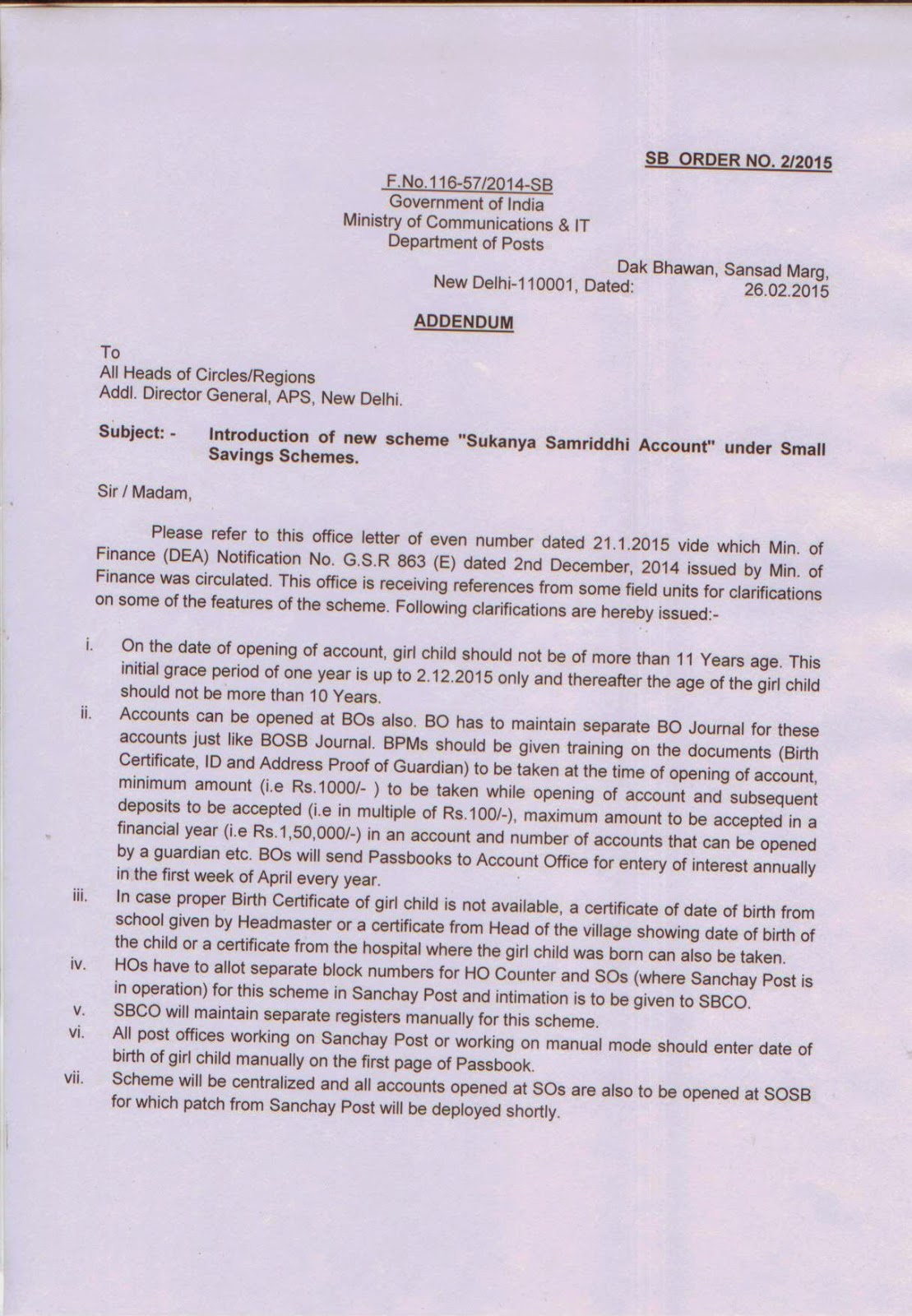
Sukanya Samriddhi Scheme: Income Tax Benefits And Other Features

The Sukanya Samriddhi Scheme has got tax-free status on interest income and withdrawal in the Budget. "Investments in Sukanya Samriddhi Scheme is already eligible for deduction under Section 80C. All payments to the beneficiaries including interest payment on deposit will also be fully exempt," Finance Minister Arun Jaitley said in his Budget Speech.
Sukanya Samriddhi Scheme is a small savings scheme which was launched in January this year and is aimed at encouraging savings for a girl child's education and marriage.
Taxation: A contribution of up to Rs. 1.5 lakh qualifies for income tax deduction under Section 80C of Income Tax Act. The clarifications in the Budget now make it clear that the entire maturity amount of the Sukanya Samriddhi Scheme and the interest earned are non-taxable, says Suresh Sadagopan, the founder of Ladder 7 Financial Advisories. In terms of tax treatment, it is on the lines of Public Provident Fund which also qualifies for Section 80C benefits, he says. Mr Ramesh says Sukanya Samriddhi Scheme is a good investment option to save for a girl child's future needs because the maturity amount is tax-free in the hands of the girl child. When the scheme was launched earlier this year, it was not clarified whether the withdrawal as well as interest would be exempted from tax.
Opening of account: The account may be opened by the guardian in the name of a girl child till she attains the age of ten years. Only one account is allowed per girl child. Parents can open this account for a maximum of two children. In case of twins or triplets, this facility will be extended to the third child. Account can be opened in post offices or authorized bank branches.
Age: The maximum age limit of the girl child for opening this account is 10 years. This year, a one-year relaxation has also been given.
Maturity: The account can be closed after the girl child in whose name the account was opened completes the age of 21. If account is not closed after maturity, the balance will continue to earn interest as specified for the scheme from time to time.
Withdrawal: Up to 50 per cent of the accumulated amount can be withdrawn after the account holder turns 18.
Interest rate: The government will every year declare the interest rate of the scheme. For 2014-15, the government would be paying 9.1 per cent interest. In comparison, PPF pays 8.7 per cent for 8.7 per cent interest in 2014-15.
Transferability: The account may be transferred anywhere in India if the girl child shifts to a place other than the city or locality where the account stands.
Deposits: The account may be opened with an initial deposit of Rs. 1,000 and thereafter any amount in multiple of Rs. 100 can be deposited. The minimum deposit for a financial year is Rs. 1,000 and maximum Rs. 1.5 lakh. Deposits in an account can be made till completion of fourteen years, from the date of opening of the account.
Penalty: An account where minimum amount has not been deposited in a particular year will attract a fine of Rs. 50 per year.
Operation of account: The account will be opened and operated by the guardian of a girl child till the girl child, in whose name the account has been opened, attains the age of 10 years. On attaining age of 10 years, the girl child may herself operate the account.
Source : NDTV
Thursday, 8 January 2015
Grant of leave to the staff working under HSG-I Postmaster
No 51-4/2011- SPB – 11
Government of India
Ministry of Communications & IT
Department of Posts
Dak Bhavan, Sansad Marg
New Delhi – 110001
Dated 01-08-2011
To,
1. All
Chief Postmasters General
2. All
Postmasters General
Sub: Grant of leave to the staff working under HSG I
Postmaster.
Sir / Madam,
It is observed that HSG.I Postmaster is competent to grant only
casual leave to the staff working under him/her. The applications for grant of
other kind of leave to staff are forwarded by him/her to the Division office
for approval. It has been brought to the notice of the Directorate that at
times the said procedure takes time and if such officials who do not have
casual leave left in their accounts want to proceed on earned leave immediately
to some unforeseen circumstances, they face problems in proceeding on leave at
short notice.
2. The matter has been looked into. It has been decided by the
competent authority in the Directorate that in such pressing circumstances, HSG
I Postmasters while recommending earned leave may relieve the official of his
duties in anticipation of grant of leave by the competent authority, provided :
I. The earned leave applied for by the individual is not for more
than the period of three days.
II. No substitute is required in case the official proceeds on
leave.
III. The leave may be recommended by the HSG I Postmaster by
recording that it is being recommended subject to the availability of leave in
the credit of the applicant.
IV. The official may be relieved after duly following the
procedure of handing/taking over of the charge.
V. If later on the sanctioning authority finds that the official
does not have the leave applied for to his credit he should obtain the revised
application from the individual for the kind of leave he/she is entitled to at
the earliest.
VI. If the official needs earned leave for more than three days or
wants to extend the earned leave beyond three days he should apply for same
well in advance so that it is sanctioned as per the existing procedure.
Yours faithfully,
-Sd-
(B.P.Sridevi)
Director (Staff)
Subscribe to:
Posts (Atom)